Read on as Ross Limjoco, our Partner at Triide Singapore, shares his insights on 4 main areas below.
Prime Minister Lawrence Wong delivered Singapore’s Budget 2026 on 12 February 2026, presenting a S$154.7 billion budget that marks a decisive pivot from immediate cost-of-living relief toward long-term economic resilience in an increasingly fragmented global landscape.
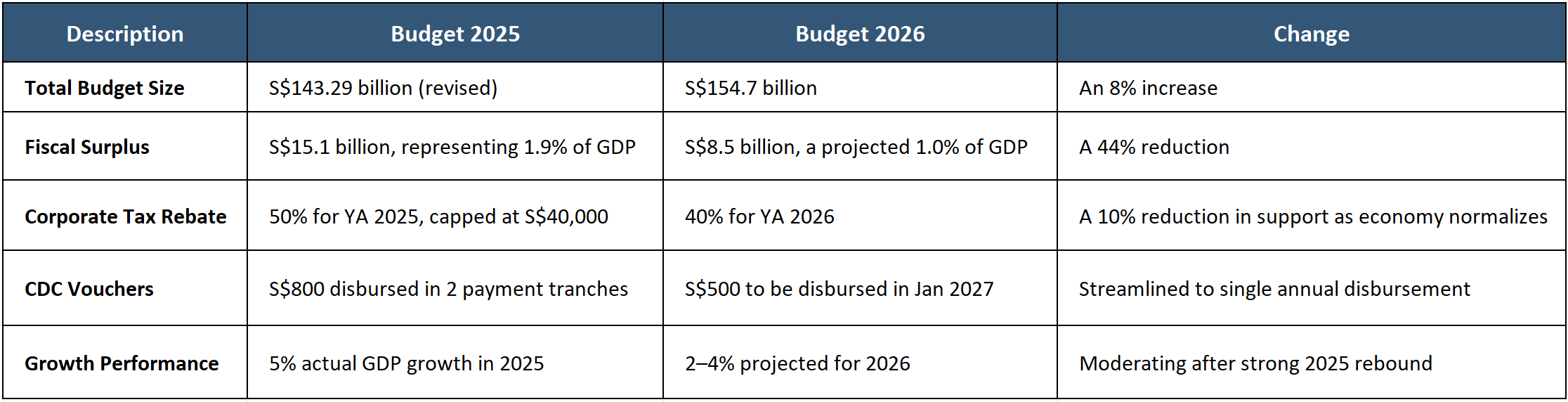
Note: Budget 2025 was initially projected to run a modest S$6.8 billion surplus (0.9% of GDP), but strong corporate tax collections pushed the actual surplus to a record S$15.1 billion more than double estimates.
1. From Crisis Response to Strategic Positioning
Budget 2025 operated in a transitional phase celebrating Singapore’s 60th anniversary with generous one-off transfers while managing post-pandemic cost pressures.
Budget 2026, by contrast, reflects confidence in Singapore’s economic resilience after 5% growth in 2025, deliberately trading fiscal surplus for strategic investments in AI, semiconductors, and supply chain anchoring.
Commentary: The reduction in corporate tax rebates from 50% to 40% signals the government’s view that businesses have regained footing after pandemic disruptions. Rather than blanket relief, support is now more targeted – the 40% rebate includes a minimum S$1,500 benefit ensuring even small enterprises receive meaningful support.
2. AI as the Central Growth Engine
Budget 2026 makes AI adoption a national priority with unprecedented tax incentives:
Commentary: While Budget 2025 introduced foundational AI support within broader R&D initiatives, Budget 2026 treats AI as a standalone strategic pillar. This reflects Singapore’s recognition that AI leadership, not just adoption, will determine economic competitiveness in the 2030s. The focus has shifted from “helping businesses survive” to “positioning Singapore at the frontier of technological transformation.”
3. Semiconductor Strategy Evolution
Commentary: This represents sophisticated industrial policy evolution. Rather than competing in capital-intensive wafer fabrication (dominated by TSMC, Samsung), Singapore is doubling down on advanced packaging – a high-value segment where its precision manufacturing ecosystem offers comparative advantage. The S$37 billion Research, Innovation and Enterprise (RIE) 2030 plan anchors this strategy alongside quantum computing and decarbonisation technologies.
4. Social Support: Targeted vs Universal
Budget 2026 introduces more means-tested support:
Commentary: This reflects fiscal prudence amid moderating growth projections (2 to 4% for 2026 vs 5% in 2025).
The government is transitioning from universal relief (appropriate during acute inflation in 2024–2025) toward targeted support for vulnerable cohorts particularly older Singaporeans with inadequate retirement savings. This aligns with Singapore’s long-standing philosophy of “helping those who need it most” rather than blanket transfers.
Budget 2026 represents Singapore’s confident transition from crisis management to strategic positioning. Where Budget 2025 provided generous but temporary relief amid uncertainty, Budget 2026 makes calibrated bets on AI, advanced manufacturing, and supply chain resilience – accepting a smaller fiscal surplus to secure Singapore’s relevance in a fragmenting world.
The reduced corporate tax rebate and streamlined CDC vouchers signal that the emergency phase is over – the focus now is on building enduring competitive advantages rather than short-term palliatives. This is a budget for the 2030s, not just 2026.
To further understand how these changes may affect your operations in Singapore, please get in touch with us. Our team can assist you to optimize and future-proof your business strategies, so you can Go Further with Confidence.
Copyright © 2026 Triide | All rights reserved. Data Protection & Privacy